Eloralintide vs retatrutide compares two Eli Lilly drugs from different classes. Eloralintide copies the hormone amylin.
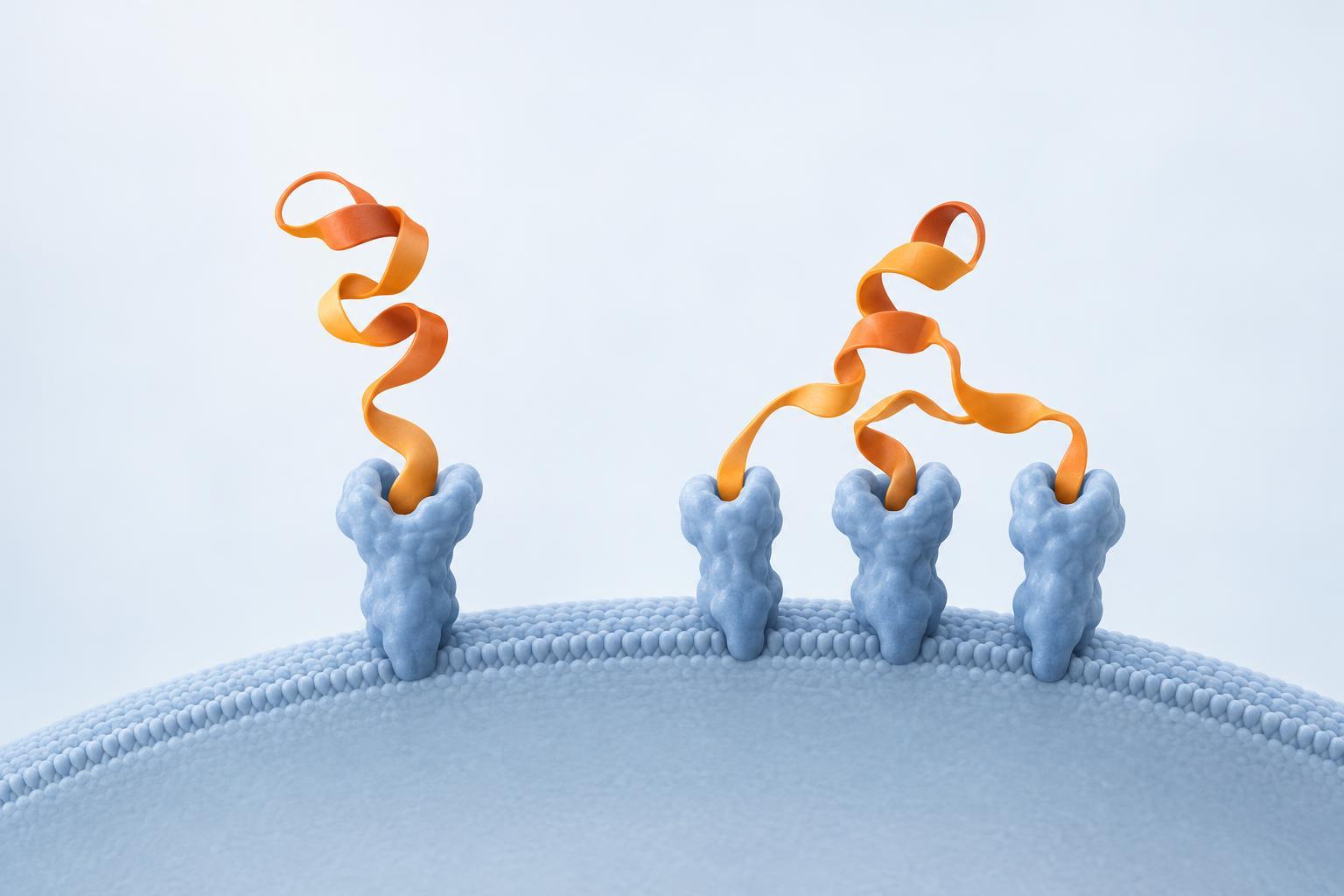
Both are Lilly drugs in trials, and neither is approved. Eloralintide is an amylin receptor agonist, not a GLP-1 drug[1]. Retatrutide acts on GIP, GLP-1 and glucagon receptors[2]. At 48 weeks in phase 2, the top arms lost −20.1%[3] and −24.2%[4] in separate trials. Retatrutide also has phase 3 results; eloralintide does not yet. No head-to-head trial and no combination trial exist.
Eloralintide: human RCT (phase 2). Phase 3 started December 2025.
Retatrutide: human RCTs (phase 3, several published in 2026). Not yet filed with FDA.
| Feature | Eloralintide | Retatrutide |
|---|---|---|
| Developer | Eli Lilly (LY3841136) | Eli Lilly (LY3437943) |
| How it works | Selective amylin receptor agonist (AMY1R)[1] | GIP, GLP-1 and glucagon receptor agonist[2] |
| Status | Phase 3 (ENLIGHTEN); first primary completions estimated 2028 | Phase 3 (TRIUMPH, TRANSCEND); Lilly plans to submit to FDA in Q1 2027 (Lilly press releases, 2026-07-23 and 2026-09-29) |
| Phase 2, 48 weeks (top arm) | −20.1% vs −0.4% placebo, efficacy estimand, n = 263[3] | −24.2% vs −2.1% placebo, n = 338[4] |
| Phase 3 (top arm) | No results yet | TRIUMPH-1, 80 weeks: −25.0% treatment-regimen, −28.3% efficacy estimand[5] |
| Half-life | 12.9–15.3 days[1] | About 6 days[6] |
| Stopped for side effects | Not reported in the phase 2 abstract | 11.3% at 12 mg vs 4.9% placebo in TRIUMPH-1 (Lilly press release, 2026-05-21)[5] |
| Heart rate | Pulse fell with dose in a 12-week phase 1b study[7] | Heart rate rose with dose, peaked at week 24[4] |
| Signature side effect | Fatigue, up to 43–46% in higher arms vs 12% placebo[3] | Dysesthesia (skin burning or tingling), 4.5–20.9% across phase 3 arms (see the retatrutide page) |
Cross-trial table. Each cell links to its own trial; the trials differ in length, population and estimand.
Is eloralintide a GLP-1? No. Eloralintide copies amylin, a hormone released with insulin that slows stomach emptying and signals fullness. In cell tests it preferred the AMY1 receptor 12-fold over the calcitonin receptor[1].
Is "GLP-3" the same as retatrutide? "GLP-3" and "reta" are nicknames for retatrutide (LY3437943); "GLP-3" is not an official name. Retatrutide is a single peptide that acts on GIP, GLP-1 and glucagon receptors. The extra energy use from the glucagon arm was shown in mice (animal data)[2].
EloraTZP is eloralintide given with tirzepatide, Lilly's own GLP-1/GIP drug. Lilly is not pairing eloralintide with retatrutide in any registered trial.
The fairest pair available is the two phase 2 trials, because both ran 48 weeks in adults with obesity and without type 2 diabetes. They are still separate trials, and the numbers use different estimands.
Same length, separate trials. Weight change at 48 weeks for each published arm.
Scale: 0–30%
Treatment-regimen estimand, n = 2,339[5]. Under the efficacy estimand Lilly reports −19.0 / −25.9 / −28.3% vs −2.2%. Eloralintide has no phase 3 result to set beside this.
A widely shared post claims that eloralintide plus tirzepatide gave about 30% weight loss at 30 weeks and "beat" retatrutide. We found no source for that figure. This is what has been reported:
| What was reported | Who | Length | Result | Source |
|---|---|---|---|---|
| EloraTZP phase 2b, people with obesity and type 2 diabetes (Company press release) | Humans, n = 367 | 48 weeks | Up to −23.3% vs −3.0% placebo (efficacy) | Lilly, 2026-09-30[8] |
| Same trial, tirzepatide alone (Company press release) | Humans | 48 weeks | −14.8% | Lilly, 2026-09-30[8] |
| Eloralintide with tirzepatide in rats (Animal) | Rats | 4 weeks | About −20% | Lilly poster 3082-LB, ADA 2026 |
A 16-week phase 1 figure also circulates in secondary coverage. We could not find its primary source, so we do not report it. Rat results do not tell you what happens in people. No trial has compared EloraTZP with retatrutide.
Scale: 0–14.4 bpm decrease
n = 100, 12 weeks, no symptomatic bradycardia reported (small human study)[7].
Retatrutide moved heart rate the other way: in phase 2 it rose with dose, peaked at week 24 and then declined[4]. The two findings come from separate, small studies. A 2026 review points out the contrast[9]. Whether it holds in larger trials is not known.
| Drug | Event | Rate | Comparison | Source |
|---|---|---|---|---|
| Eloralintide | Fatigue (phase 2) | 0–46% by arm | 12% placebo | [3] |
| Eloralintide | Nausea (phase 2) | 11–64% by arm | 14% placebo | [3] |
| Eloralintide | Depressed mood or depressive disorder (phase 1b) | 4 of 59 people on 6–12 mg | no placebo figure in the source | [7] |
| Retatrutide | Nausea (TRIUMPH-1) | 28.6 / 38.4 / 42.4% | 14.8% placebo | Lilly, 2026-05-21[5] |
| Retatrutide | Dysesthesia (TRIUMPH-1) | 5.1 / 12.3 / 12.5% | 0.9% placebo | Lilly, 2026-05-21[5] |
| Retatrutide | Stopped for side effects (TRIUMPH-1) | 4.1 / 6.9 / 11.3% | 4.9% placebo | Lilly, 2026-05-21[5] |
Each drug's most distinctive side effects, from its own trials.
In the eloralintide phase 1b study, the three people on 12 mg with mood events stopped treatment and the events resolved in 2 to 4 days[7]. For both drugs, stomach and gut side effects became more common at higher doses.
No trial has given eloralintide and retatrutide together. Lilly's eloralintide combination is with tirzepatide: EloraTZP finished phase 2b[8] and is in phase 3[10][11].
ClinicalTrials.gov, searched 2026-11-17
More on EloraTZP is on the eloralintide page. For retatrutide's other comparison, see retatrutide vs tirzepatide.
| Claim | Verdict | What the source says |
|---|---|---|
| Eloralintide plus tirzepatide gave 30% weight loss at 30 weeks | No source found | Phase 2b: up to −23.3% at 48 weeks (Lilly press release)[8] |
| Eloralintide "generally avoids" the heart-rate rise (search summary) | Stronger than the evidence | One 12-week study of 100 people found pulse fell[7] |
| Eloralintide 20.1% vs retatrutide 28.3% in one row (a ranking comparison page) | Not comparable | Phase 2 at 48 weeks vs phase 3 at 80 weeks[3][5] |
Eloralintide phase 2 published online in the Lancet.
Billings et al., Lancet 2025[3] Human randomised trialRetatrutide's first phase 3 readout (TRIUMPH-4, knee osteoarthritis).
Lilly press release; paper NEJM 2026[12] Company press releaseTRIUMPH-2 and TRIUMPH-3 toplines; Lilly says it plans to submit retatrutide to FDA in Q1 2027.
Lilly press release[14] Company press releaseEloraTZP phase 2b results announced; not yet peer-reviewed.
Lilly press release[8] Company press releaseFDA states retatrutide cannot be used in compounding under federal law.
FDA statement on unapproved GLP-1 drugs[15] RegulatorTRANSCEND-T2D-2: retatrutide against semaglutide in type 2 diabetes, topline.
Lilly press release[16] Company press releaseEarliest estimated primary completion of an eloralintide phase 3 trial.
ClinicalTrials.gov[13] Trial registryDirect answers to what people search for. Bracketed numbers point to the sources at the end; the sections above have the detail.
No. Eloralintide is an amylin receptor agonist[1]. Retatrutide is the one that acts on GLP-1 receptors, along with GIP and glucagon receptors.
No trial has compared them. At 48 weeks in separate phase 2 trials, the top arms lost −20.1% on eloralintide and −24.2% on retatrutide. Retatrutide also has phase 3 data; eloralintide does not yet.
"GLP-3" is an informal nickname for retatrutide, used because it acts on three receptors. It is not an official drug name.
No trial has tested the two together (ClinicalTrials.gov, searched 2026-11-17). Lilly's tested eloralintide combination is with tirzepatide (EloraTZP).
In a 12-week study of 100 people, pulse fell with dose, by 14.4 bpm at 12 mg vs 3.4 bpm on placebo[7]. Retatrutide raised heart rate in its phase 2 trial.
Retatrutide is further along: Lilly plans to submit it to FDA in Q1 2027. Eloralintide's first phase 3 trials are estimated to finish in 2028. Neither date is an approval.
No trial has compared them. EloraTZP reached up to −23.3% at 48 weeks in people with type 2 diabetes, in a press release that is not yet peer-reviewed.